
The word “attestation” refers to verification or proof of authenticity. You need a passport, a visa, and other required documents while travelling overseas for business, school, employment, or any other purpose. Each of these documents has a legal process.
Verifying the documents you plan to use for employment, school, business, etc., in a foreign nation is a procedure. For instance, if you reside in Chennai, getting your certificate attestation in Chennai confirms that your documents are officially verified and accepted for use in foreign countries. This article gives you a thorough understanding of the various forms of attestation and their distinctions.
Types of Attestation
Embassy Attestation
Here, the relevant embassy of the nation where you applied attests to your paperwork. The last stage is embassy attestation. Prior to that, your document must be attested at the state, regional, and Ministry of External Affairs (MEA) levels.
MOFA Attestation
The ministry in charge of preserving international ties is called the Ministry of Foreign Affairs, or MOFA for short. An MOFA attestation is required for your documents if you are visiting any of the Gulf nations listed below.
- Bahrain
- Kuwait
- Oman
- Qatar
- Saudi Arabia
- United Arab Emirates
The concerned nation’s embassy offers an attestation for papers in the Embassy Attestation. However, the state, embassy, MEA, region, and MOFA are all involved in the MOFA certification process.
Apostille Attestation
MEA attestation is another name for it. The Ministry of External Affairs (MEA) has the authority to attest to papers that are acceptable for use in nations covered by the Hague Apostille Convention. You may be wondering, what exactly is the Hague Apostille Convention?
It is a 1961 rule or act that eliminates the need for member nations’ governments to repeatedly verify international public papers.
Apostille attestation is a method of attesting the necessary documents to make them accepted in any nation listed in the Hague Convention.
More than 116 nations have legalised it, and the majority of European and American nations recognise the format.
Here are some explanations with examples:
For example, your child’s school admittance in the UK would require your birth certificate to have an MEA apostille stamp on it.
Generally speaking, you must adhere to the procedures of embassy attestation. In this process, the concerned nation’s embassy issues an attestation after carefully examining the document’s legitimacy.
However, in the case of the MEA Apostille, the Apostille Attestation process does not include the embassy of the Hague Apostille Convention member nation.
Types of Documents Required for Attestation
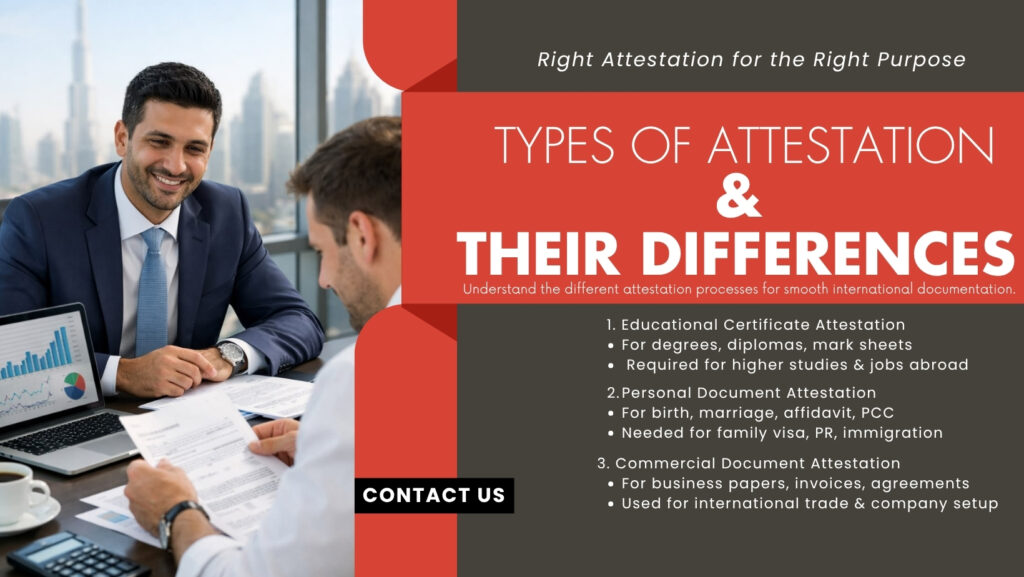
Educational Documents
These comprise all of your academic records, including your grade reports, your B.Tech. or B.Com. degree, your chartered accountant degree, your MBBS, BE, MS, MD, HSC, and SSC, degree, nursing, and diploma certificates, among others.
Non-Educational/Personal Documents
Non-educational/personal documents include birth certificates, marriage certificates, leave certificates, offer letters, genuine certificates, registration certificates, medical certificates, and more.
Commercial Documents
Commercial documents include things like export invoices, power of attorney, certificates of origin, packaging lists, chemical analysis reports, and certificates of incorporation.
Procedure of Embassy Attestation
Here are the three main steps to receive an embassy Attestation for educational, non-educational, and commercial documents:
Steps for Educational Documents Embassy Attestation
The state Human Resource Department (HRD) must first authenticate educational documents at the regional level.
The Ministry of External Affairs (MEA) examines the documents following the state HRD.
Ultimately, the embassy of the relevant nation confirms that the document is legitimate for usage by signing or stamping it with an attestation.
Steps for Non-Educational Documents for Embassy Attestation
Similar to educational documents, non-educational ones must first be attested at the regional level before being sent to the state home department.
Once the home department has verified the document, the embassy and MEA show that it is valid for usage by signing or stamping it.
Steps for Commercial Documents Embassy Attestation
The Chamber of Commerce verifies the documents for the embassy attestation this time.
The MEA and Embassy must confirm the document once again for an attestation stamp, signature, or certificate following the initial authentication.
MEA Apostille Procedure
If you have carefully read the blog, you are aware that the embassy attestation process consists of four steps. However, since the MEA apostille does not include the embassy, the apostille procedure consists of only three steps.
Step 1- Regional Level
Each form of document has a separate route, and this level of legalisation can be completed from the place where the documents were issued.
Step 2- State Level
In this case, the documents are state-level authenticated and, depending on the type of document, can be checked by various authorities. The State Home Department (SHD) and the Human Resource Department (HRD) are these authorities.
Prior to the MEA apostille, the state HRD must confirm the educational documents.
The SHD is required to verify the non-educational and personal documents.
Additionally, the Chamber of Commerce Department attests to business documents.
Step 3- MEA attestation
After all three types of documents have been confirmed at the regional and state levels, the MEA examines them and applies an MEA stamp or sticker.
Common Attestation Myths Debunked
Many believe apostille replaces embassy attestation entirely, but this is false. It only applies to Hague Convention countries. Another myth: all documents need MOFA for Gulf travel. No gain, as it follows HRD/SHD and MEA steps first.
Skipping regional authentication risks rejection. Notarisation alone isn’t enough, and full legalisation ensures validity. Understand these differences to avoid delays and extra costs in your overseas document process.
Final Thoughts
Now you have a clear understanding of the different certificate attestation services in Chennai and how they work. To ensure fast, reliable, and accurate processing, it’s important to work with an experienced agency. Talent MEA Center has years of expertise in handling all types of attestation, including embassy attestation and MEA apostille services. They also provide document translation and tracking facilities, making the entire process smooth and hassle-free.
For professional, trustworthy, and timely service, contact Talent MEA Center today and get your documents verified with confidence.